The hard part of a first self-drive in Western Sichuan is not navigation but the sudden weather at passes like Zheduo, the endless curves and lorries on the national roads, and how a car behaves at altitude with less power. This guide covers what to watch before setting off, while driving, and when something goes wrong.
Western Sichuan's bar for self-driving is lower than many expect, and higher than many expect. Lower, because the roads are well built, tunnels are common and navigation works; higher, because in a single day you may meet sunshine, thick fog, sleet and strong crosswinds, across a stretch where the altitude change can exceed two thousand metres.
Three conclusions. First, confirm what kind of route you are taking: Chengdu to Kangding is now motorway, while Kangding to Xinduqiao crosses Zheduo Pass, the stretch that demands the most attention on a first self-drive. Second, keep each day's driving to four to six hours and do not cross a pass in the evening to reach your accommodation. Third, preparing the vehicle and insurance matters more than the route itself: at altitude the car loses power, and long descents are a genuine test for the brakes.
This article answers one question only: on a first self-drive in Western Sichuan, what to watch before setting off and while on the road. It suits drivers with city and motorway experience but none on highland mountain roads. Road conditions, restrictions and petrol station coverage all change; this was compiled in September 2026, so follow traffic authorities and local official announcements on the day.
Before you set off: car, documents, insurance, navigation
On the car, look at two things first: power and braking. Western Sichuan has large altitude changes, and a naturally aspirated engine loses noticeable power above 4,000 metres, so allow more distance for overtaking; as for the brakes, expect long descents and use a low gear with engine braking rather than holding the pedal down.
For documents, carry your licence, vehicle registration and insurance policy. If you hire a car, check its inspection status and whether a spare wheel and tools are provided, and photograph its condition at collection, especially the underside and tyres.
Insurance has two layers to keep straight: vehicle cover and travel accident cover. For highland self-driving, confirm whether the policy includes roadside assistance and towing distance, and whether it restricts high-altitude use; asking your insurer directly is the most accurate route.
Rely on offline maps. Signal is patchy along parts of the route, so download the day's route before setting off and note two numbers: the motorway rescue line and the ordinary-road accident line.
What makes Western Sichuan's roads difficult
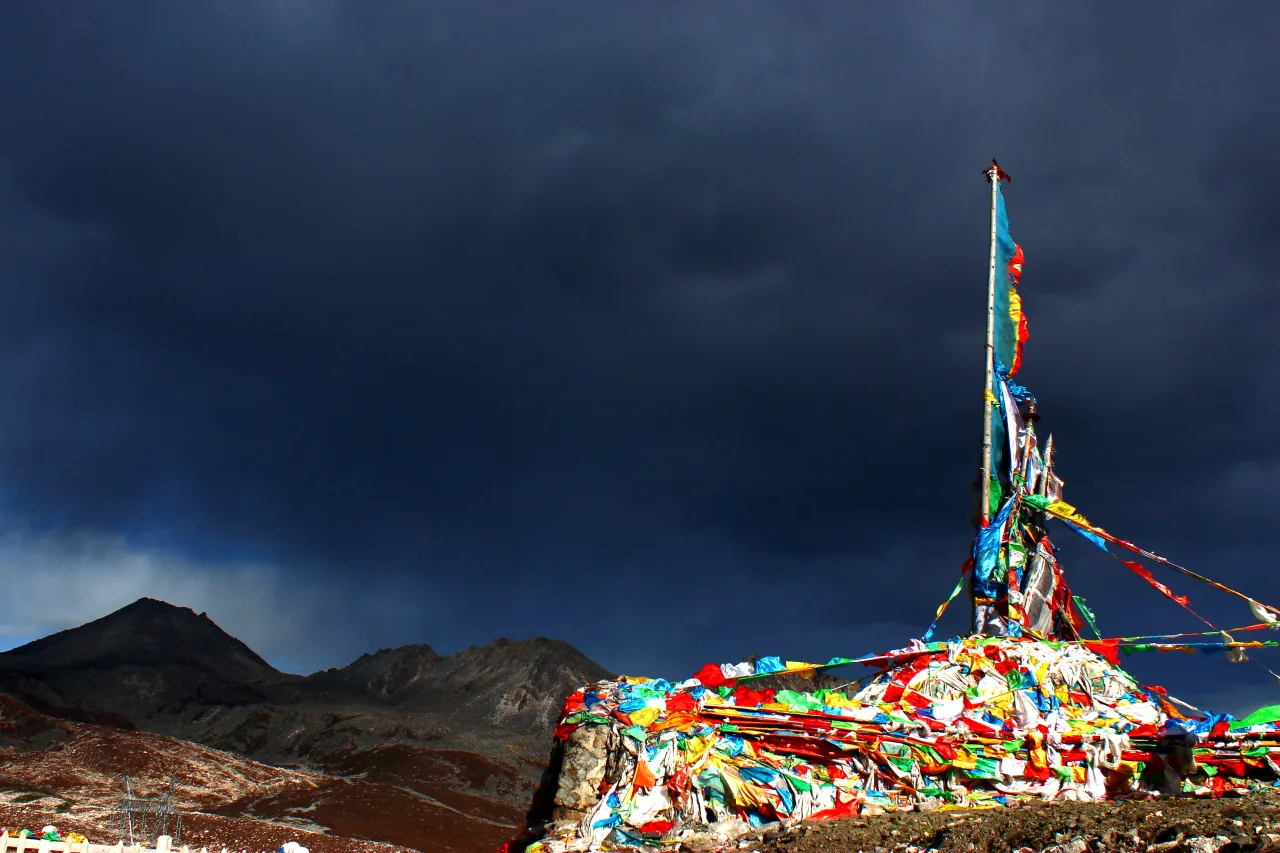
The difficulty is not bad roads but fast change. On the same national road, the morning may be clear and straight, and the afternoon may bring fog and crosswind at a pass. Zheduo Pass sits at around 4,298 metres and is the stretch many first-time drivers find genuinely tense: continuous curves, rapidly switching weather and plenty of cars parked for the view.
Another challenge is tunnels. Many high mountain sections now have them, which speeds up the journey, but the change in light entering and leaving, the tunnel speed limits and the need to judge the gap to the car ahead all take adjusting to. Crosswinds near tunnel mouths give noticeable feedback through the steering wheel.
A third category, easily underestimated, is township and village roads. For places such as Dangling or Mosika the final stretch is often narrow with few passing places, and oncoming traffic means finding a wider spot to give way. If you are not confident, do not push on.
Speed limits, cameras and lorries: driving the national roads
Speed limits on national and provincial roads change frequently, with both average-speed and fixed cameras, and plenty of stretches limited to between 30 and 60 km/h. The safe approach is to follow the navigation's limit warnings and slow down before entering villages and towns.
Lorries are the main variable. Western Sichuan's national roads carry heavy freight: lorries are slow on climbs, so overtaking needs a long, clear straight; on descents they gather speed and their brakes are audible, so do not follow closely.
Three habits help: never cross into the oncoming lane on a bend, confirm a straight with enough distance before overtaking, and stop only at proper viewing lay-bys, never on a bend or the shoulder.
What changes in a car at altitude
Loss of power is the most obvious: on climbs, change down early for overtaking and allow more distance and time. Fuel consumption rises in step, and climbing sections drink more than on the plains, so refuel whenever you pass a station and do not rely on reaching the next one.
Tyres and brakes both need active checking. Before a long descent, checking the temperature of the brake pads, or feeling the wheel hubs by hand, helps you judge; tyre pressures shift on stretches with wide day-to-night temperature swings, so set them to the manufacturer's recommendation rather than over-inflating on instinct.
In winter, chains and black ice come into it. Shaded sections at passes can freeze in the early morning and the ice is hard to see, so the basics are slow speed, no sharp steering and no sudden braking. Without experience of driving on ice and snow, a chartered car is the better winter choice.
What to do about closures, rockfall and breakdowns
For a road closure the order is: pull over somewhere safe, confirm how far the restriction extends, and follow on-site traffic instructions to detour or wait. Do not attempt a minor road instead, because Western Sichuan's small roads are often more dangerous.
Rockfall is most likely after rain and in the early morning. Through rockfall-prone sections the principle is to watch above, pass quickly and not stop for photos. If stones are already on the road, slow down and drive over them rather than swerving sharply.
If the car breaks down, secure personal safety first: move it to the shoulder or somewhere safe outside a tunnel, switch on the hazard lights, wait outside the barrier and then call for assistance. Waiting at altitude can take a while, so carry enough water and warm clothing, which matters especially in winter.
Frequently Asked Questions
Q: I have never driven mountain roads. Can I self-drive in Western Sichuan for the first time? A: Yes, but start with the established circuit (Chengdu, Kangding, Xinduqiao, Danba, Siguniang) and keep daily driving to four or five hours, avoiding several consecutive days of long transfers.
Q: Do I need a permit to self-drive in Western Sichuan? A: Not for ordinary scenic areas and national roads, which covers the vast majority. A few border or specially managed areas may have extra requirements, so check local official announcements before you travel.
Q: Can I drive mountain roads at night? A: Better not. No street lighting, livestock crossing, rockfall and fatigue stack up, and the risk rises noticeably. Keeping to daylight driving is the most effective way to reach your accommodation before dark.
Q: What if the hire company does not allow the car at altitude? A: Some rental contracts restrict the areas you may drive. Check the terms before collecting the car and, if necessary, choose a model and product that permits highland driving, avoiding a dispute if something happens.
Wrapping up
Preparing to self-drive in Western Sichuan comes down to one sentence: clear the car and the insurance first, drive with navigation and speed warnings on, keep each day to four to six hours, and reach the hotel before dark. What needs watching is not the road but the rhythm, since rushing is the most common cause of trouble at altitude.
One more easily missed detail: if only one of your party drives, shorten each day's driving by another hour. Fatigue shows up more clearly at altitude than on the plains, and it is the hardest risk to quantify and the hardest to correct after the fact.
A reminder: road conditions, traffic controls, petrol station hours and restrictions all change. This was compiled in September 2026; follow traffic authorities and local official announcements on the day you travel. If the route includes high-altitude stretches, prepare for altitude at the same time; see Preventing altitude sickness on a first trip to Western Sichuan; for route choices see How to prioritise Western Sichuan's sights。
If you are unsure whether the intensity of your route suits you, tell 0765trip's Western Sichuan route consultants your vehicle type, driving experience, travel party and planned days, and a consultant will suggest a pace based on the season's road conditions; or compare directly with the ready-made 6-day Western Sichuan route to see whether each day's distance and overnight stop is within your comfort zone.